阅读并同意隐私协议、MTA和使用条款后进行下一步!
The road from candidate to clinic passes two critical gates: the degree of humanization and the risk of immunogenicity. In 2026, an international blind test published in Nature Biotechnology gave the field a sobering answer: 29 organizations submitted 511 AI-designed antibody sequences against a single target, all synthesized and assayed by an independent third party. The best design reached 95 pM affinity — roughly 2,000-fold better than its parent — on par with the best molecule obtained by experimental screening (113 pM). For affinity maturation tasks with sufficient data and a clear objective, AI can already deliver molecules that are genuinely usable.
But the same test exposed the other side. When asked to rank a pool of candidates, most models could not beat a simple baseline that picks the most frequent residue at each position. The closer a task came to de novo design, the more designs — about 30% — showed no binding at all. Most importantly, high affinity and clean developability (hydrophobicity, polyreactivity, self-aggregation, thermal stability) did not reliably arrive together.
In other words, AI has become increasingly fluent at the affinity gate; what actually blocks a candidate from becoming a drug is developability. And among those issues, humanization and immunogenicity are essential.
01PAIN POINTS
Look at a development engineer's daily work and the most common problems are rarely "we cannot design a binder". They are these four:
All four point to the same conclusion: humanization is no longer a step you "add at the end"; it belongs at the design stage, where it can be quantified, compared and verified alongside affinity.
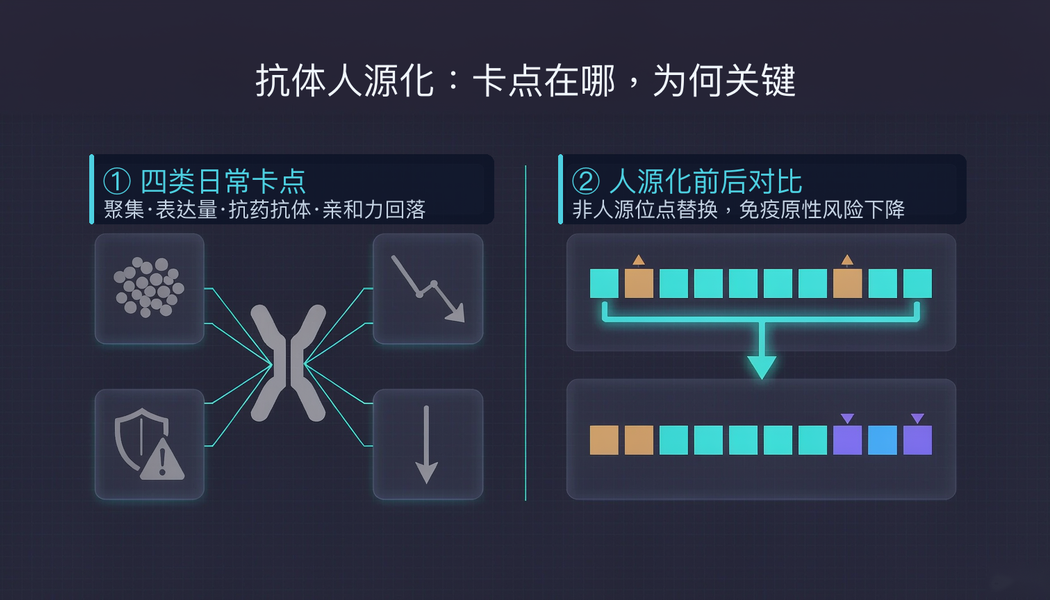
Four recurring pain points (top) and the sequence before and after humanization (bottom)
02WHY IT MATTERS
Humanization reshapes the variable region of a non-human antibody so that it resembles human sequences more closely, reducing immunogenicity. The immunological logic is straightforward: once a therapeutic protein is processed by antigen-presenting cells, any "non-self" peptides may be presented to T cells and drive anti-drug antibody responses. Making a sequence more human is, in essence, sanding down those potential foreign epitopes.
Over the past two years the field has been moving humanization from craft to quantitative design. In 2026, the Sormanni group — a collaboration between the Centre for Misfolding Diseases at the University of Cambridge and Imperial College London — published AbNatiV2 in mAbs: a model trained on no fewer than 20 million antibody sequences that quantifies how much a sequence belongs to the natural immune repertoire distribution (its nativeness) and uses that to guide humanizing mutations. Its companion p-AbNatiV2, fine-tuned on 3.7 million paired human sequences, assesses heavy–light chain pairing likelihood and ranks native pairings higher in 74% of held-out cases.
Earlier still, the BioPhi platform turned humanization into something explainable: it slices an antibody into 9-mer peptides and reports, segment by segment, how often each appears in human repertoires, pinpointing exactly which stretches look non-human. On its OASis percentile scale, murine antibodies sit at a median of about 5–7%, humanized antibodies around 37–40%, and human antibodies around 80–81%; the humanization score is negatively correlated with ADA responses across 217 therapeutic antibodies — giving a comparable yardstick for how human is human enough.
One boundary that must be stated: these computational scores are risk proxy metrics for immunogenicity, not patient ADA incidence rates. Whether through MAPPs presentation assays or human T-cell assays, academia and regulators (FDA, EMA) agree: the numbers help identify risk, compare candidates and target optimization, but they cannot replace experiments or be converted directly into clinical incidence. Humanization therefore requires a closed loop of computation plus experiment.
03SOLUTION
To meet an industry challenge that demands staying human-like while preserving function — and being able to verify it — Kangma-Healthcode's answer is to move humanization from after-the-fact remediation to the starting point of design, closing the loop of assessment, design and synthetic validation in a single chain. D2PLab does this in three layers.
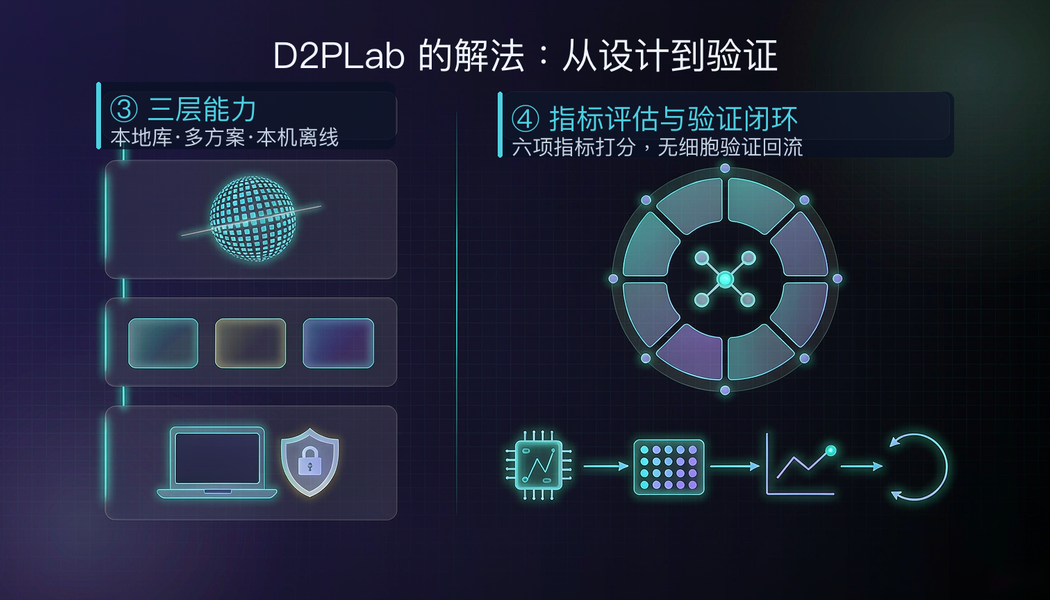
D2PLab's three capabilities (top) and the metrics-to-validation loop (bottom)
04HOW TO
Select the VH/VL sequence to engineer in the sequence editor, right-click "Humanization design", set the source species, target germline and CDR retention policy as needed, then run. You get multiple designs with different trade-offs: conservative (minimum edits, affinity first), balanced (human-likeness and function), and aggressive (push human-likeness further).
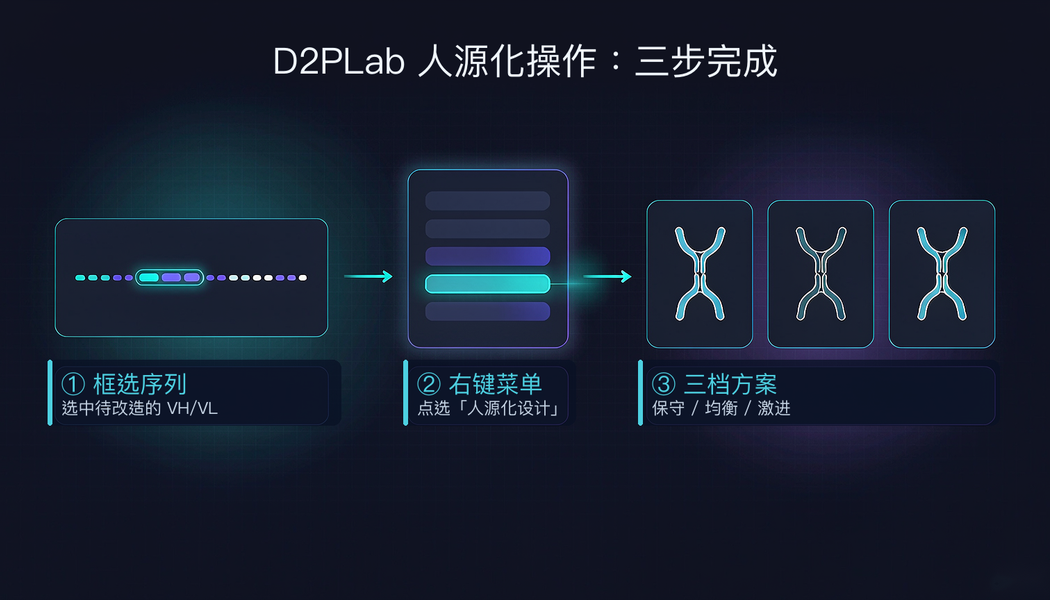
Three steps: select the sequence, use the menu, get three humanization tiers
05METRICS
Every design is scored on an industry-recognized panel of metrics, so it is clear which one is more human-like and which is more robust:
| Metric | Question it answers |
|---|---|
| Human-likeness / nativeness | How human overall |
| Germline identity | How human is the framework |
| CDR conservation & back-mutations | How much the binding region changed |
| VH–VL pairing likelihood | Do heavy and light chains fit |
| MHC-II peptide density | Where the immunogenicity risk sits |
| Structure & developability (RMSD, pI, aggregation) | Will it develop into a drug |
06VALIDATION
Scoring is the start; validation is the finish. D2PLab wires validation directly into the workflow:
07IN CLOSING
AI makes antibodies easier to make, but what decides how far a candidate travels is whether it can become a drug. On that road, humanization and immunogenicity assessment cannot be skipped and should not be left to the end. D2PLab aims to move this step to the design stage: the locally embedded repertoire and interpretable algorithms take care of thinking it through, while the cell-free manufacturing system takes care of verifying it fast — so every humanized candidate moves from design to validation ahead of the curve.
08FREE DOWNLOAD
Building on world-leading cell-free protein synthesis technology, Kangma-Healthcode created D2PLab, the EDA of biomedicine — a molecular design tool free to download for research institutes and laboratories in scientific research, drug discovery and AI protein design. D2PLab runs fully offline on a single machine or with networked compute: unified project management, remote AI models and intelligent computing, and one-click submission for synthesis, covering the entire chain from sequence design to intelligent protein manufacturing. D2PLab now serves more than a thousand laboratories, research institutes and AI technology companies worldwide.
Apply for free download at www.D2PLab.com
●●● END