阅读并同意隐私协议、MTA和使用条款后进行下一步!
AI FOR SCIENCE
From Virtual Prediction to Physical Manufacturing: How the D2Pi-2.0 Protein Manufacturing Closed Loop Runs
AIPL · AI and the Dry–Wet Loop
AI models can now generate tens of thousands of protein sequences a day. What actually sets the pace is the step after that: whether these sequences have activity can only be known once they are made, and one round of conventional cell expression takes weeks. Fast computing and slow validation — that is the most practical problem in AI protein R&D today.
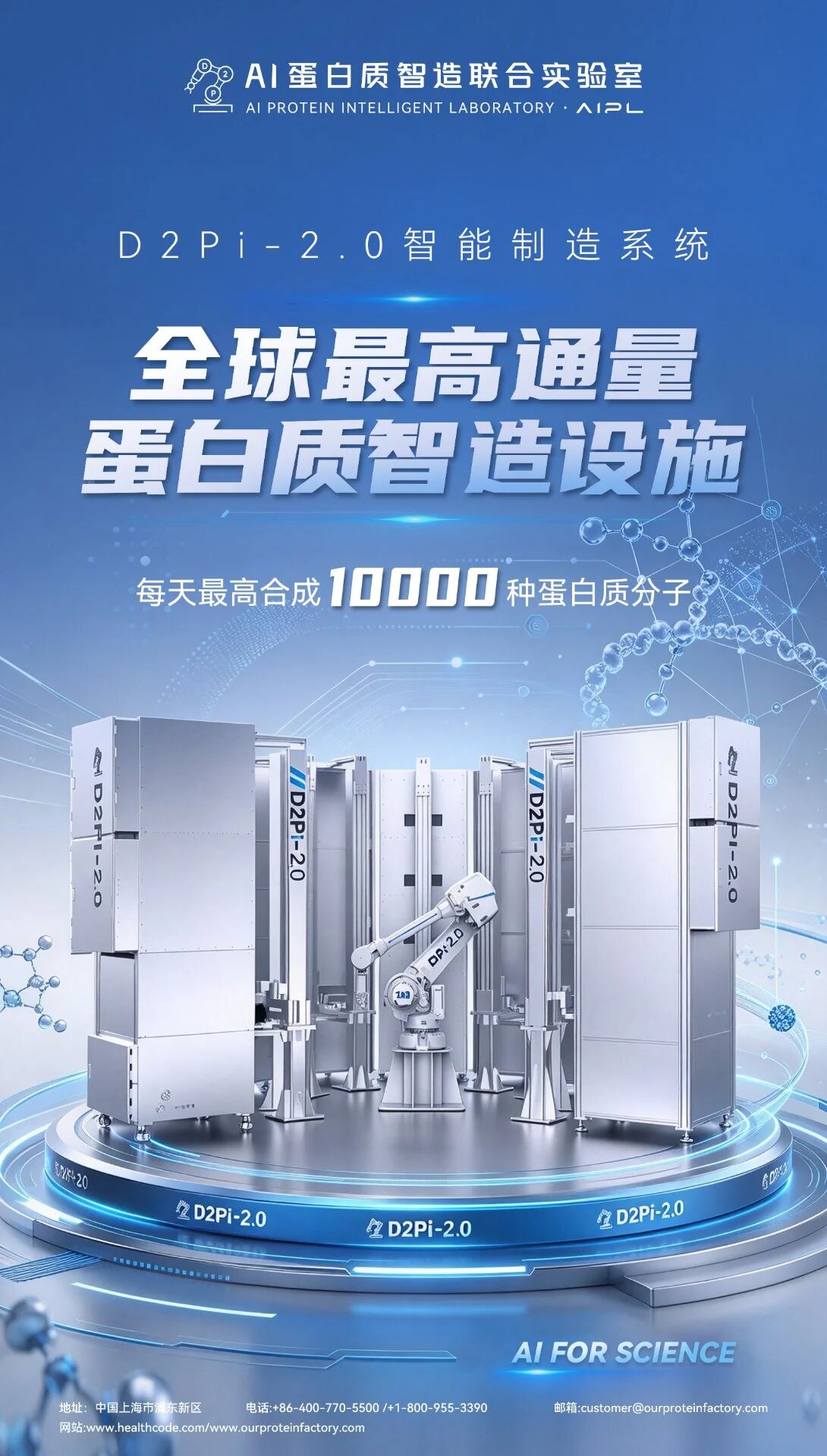
The D2Pi-2.0 intelligent manufacturing system was designed to close that speed gap. We connect AI design software with fully automated cell-free synthesis hardware, so that a sequence can go from prediction to a physical product, and the product data can be sent back to the model — forming a repeatable closed loop.
The first leg of the loop happens on the software side. Healthcode's self-developed D2PLab protein AI software has a built-in 280-million-scale protein database and can predict sequences across four dimensions: structure, stability, immunogenicity and codon usage.
Designed sequences are dispatched to the D2Pi workstation with one click — no manual transcription or intermediate format conversion.
On the hardware side, the system is designed for a throughput of up to 10,000 protein molecules per day. Once sequences are dispatched, synthesis, purification and fluorescence detection run continuously within a single system, and process data is captured in real time.
What truly sets this system apart from ordinary automation equipment is data feedback. Synthesis results, purification yields and fluorescence readings are automatically returned to the AI model for the next round of training.
AI dispatches sequences for high-throughput synthesis, purification and detection
↓
Experimental data flows back to the model for training iterations
↓
Optimized designs are dispatched again for validation
Leveraging the efficiency of cell-free synthesis, one round of experimental synthesis and validation for protein design can be completed within a week at the fastest. For algorithm teams, the feedback cycle is compressed from quarters to weeks — and the number of iterations directly determines how fast a model converges.
D2Pi-2.0 was developed jointly by biologists, chemists, computer scientists and engineers, with robotics and Physical AI taking on execution and scheduling. Comparable overseas products mostly offer only a single functional module without an accompanying cell-free system, so the dry and wet segments are usually purchased separately and operate in silos.
AI algorithms from the same system are also used in structure determination: data processing for cryo-EM and X-ray crystallography is shortened from weeks to hours, providing a basis for drug target design.
The D2Pi-2.0 ultra-high-throughput cell-free protein screening platform officially opened to the public in April 2026, providing services to society as a whole and taking on all kinds of protein design and high-throughput screening needs. It serves customers with multiple target proteins who need to quickly validate expression and complete preliminary screening — including research institutes, university laboratories, AI companies, biopharmaceutical companies, biomanufacturing and biotech companies, and schools. The platform currently serves companies and research institutions in biopharma AI design, biomanufacturing, food health, innovative drug R&D and other fields, continuously responding to high-throughput protein screening R&D needs and fully opening up to society.
The application process has three steps:
Annual capacity 30,000 tons | World No.1 on three metrics
Healthcode is a leading company in the global industrialization of cell-free protein synthesis, with the world's leading DNA-to-Protein (D2P) cell-free protein synthesis industrialization technology.
In 2023, the company built the world's first hundred-ton-scale cell-free protein synthesis industrial production line, and the world's only ten-thousand-ton-scale capacity for cell-free protein synthesis end products. Today, Healthcode's annual capacity reaches 30,000 tons, ranking first in the world!
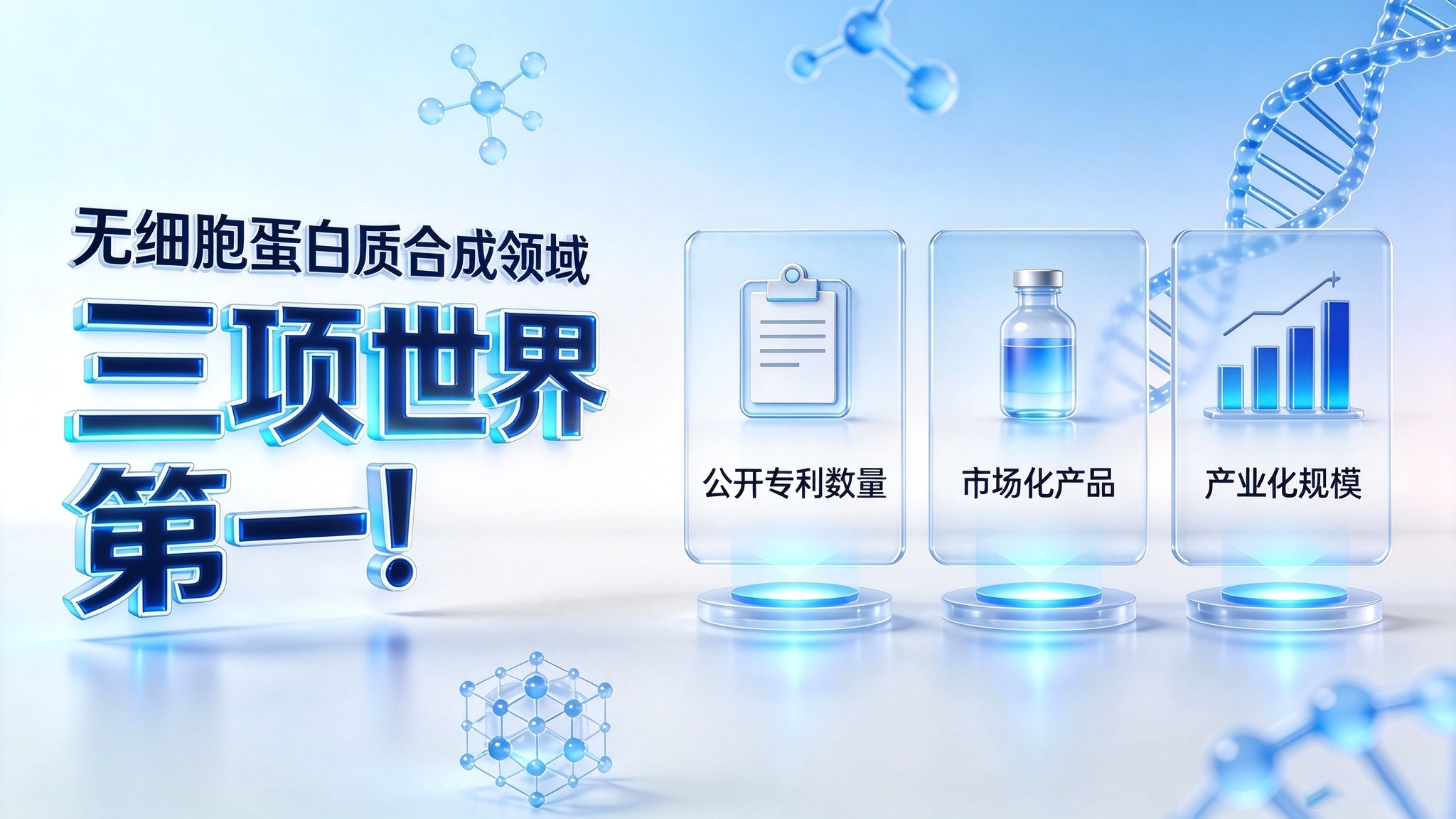
In cell-free protein synthesis, Healthcode ranks first in the world on three metrics — published patents, industrialization scale and marketed products!
With full-chain advantages in technology, production lines, capacity and market, it continues to lead and advance the global industrialization of cell-free protein synthesis.