阅读并同意隐私协议、MTA和使用条款后进行下一步!
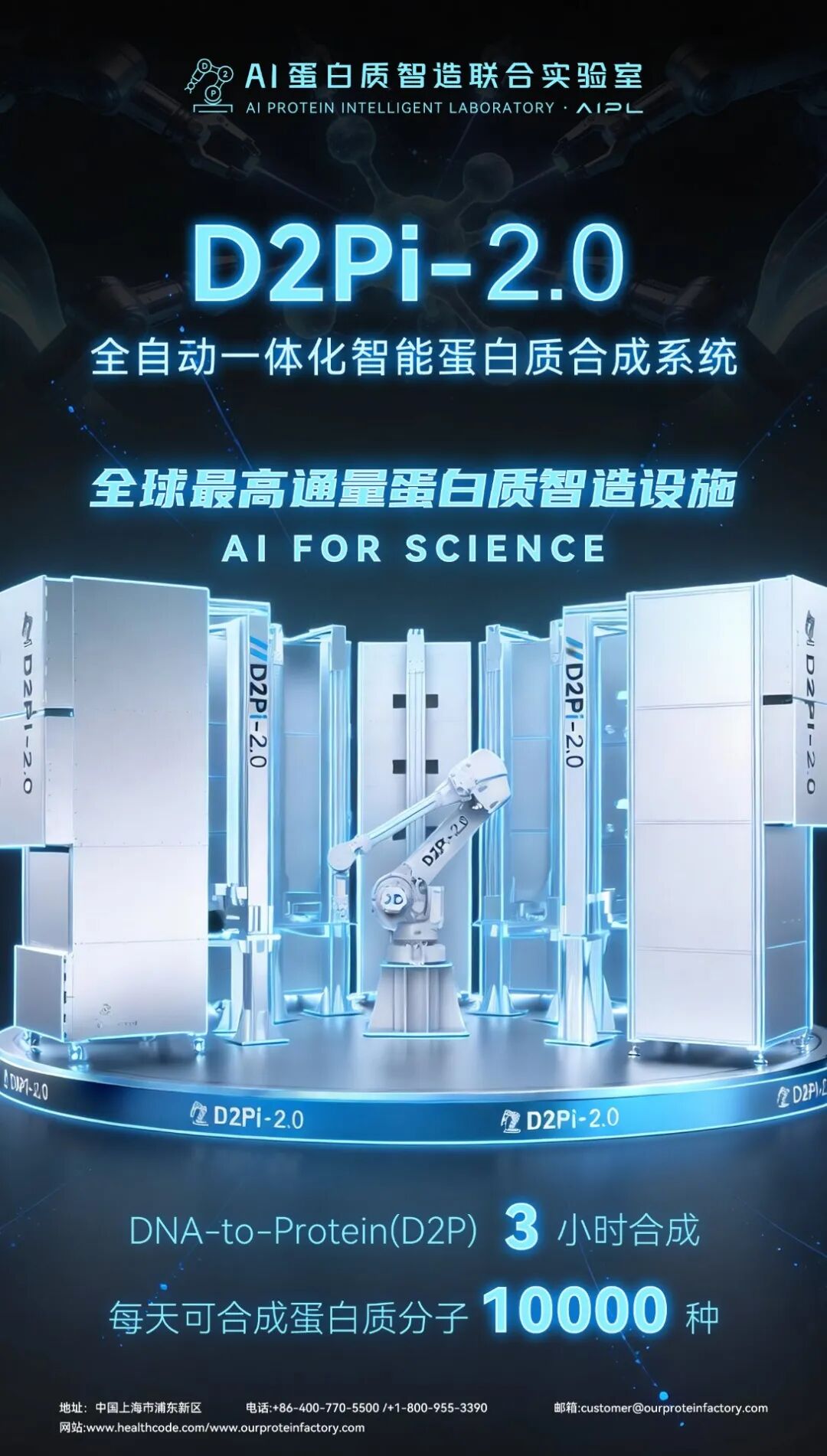
The AI Protein Intelligent Manufacturing Laboratory (AIPL) introduces D2Pi-2.0, a fully automated cell-free protein manufacturing system. Its design throughput is 10,000 protein molecules per day. Built on Healthcode's proprietary D2P cell-free protein synthesis technology, the cycle from DNA sequence to protein product takes about 3 hours.
Conventional protein expression depends on living cells: the cells must grow, and grow fast, before protein can be produced. D2P technology comes from a eukaryotic system and skips this step.
This brings several direct results. A brand-new sequence designed by AI that has no natural host can still be synthesized; proteins toxic to host cells no longer require modifying the sequence itself in order to be expressed. The sequence space that can be explored is therefore far larger.
The gap in speed is on a different order of magnitude: compared with conventional cell culture, D2Pi-2.0 is 200 times faster and delivers 100 times higher throughput.
Gene synthesis → template construction → protein synthesis → protein purification → activity assay → affinity determination → enzyme activity assay → mass spectrometry characterization → circular dichroism → electron microscopy structure elucidation.
Healthcode's self-developed intelligent large model orchestrates the process in the center, and with robotic arms and robots links these steps into one continuous pipeline that supports parallel processing across multiple production lines. The entire system is independently designed and developed by Healthcode, with ultra-high-throughput cell-free synthesis and purification integrated as a core process innovation, and 100% localized, independently controllable software and hardware.
For AI protein research, this pipeline serves as the underlying physical infrastructure.
Imported equipment typically has four problems in such scenarios: fragmented modules, insufficient throughput, missing supporting systems, and unstable supply chains.
The complete mechanical structure, fluid control, AI coupling algorithms and dedicated consumables of D2Pi-2.0 are all independently developed, addressing each of the four shortfalls one by one.
Healthcode is committed to advancing the domestic substitution of high-end instruments and safeguarding the security of industrial supply chains. Breaking the monopoly of overseas equipment such as Tecan and Hamilton, with the complete instrument, control algorithms and magnetic bead consumables all self-developed, it avoids the risk of being constrained by imported supply chains. The complete instrument, supporting consumables and software system have been tested and validated at multiple 985 universities and research institutes, outperforming imported equipment at the same price. This also fills the gap in domestically produced fully automated cell-free protein synthesis (CFPS) equipment, in line with the direction of domestic substitution for high-end bio-manufacturing instruments set out in the 14th and 15th Five-Year Plans.
The D2Pi-2.0 ultra-high-throughput cell-free protein screening platform officially opened in April 2026, providing services to society at large and undertaking protein design and high-throughput screening projects of all kinds. The service is intended for customers with multiple target proteins who need to quickly verify expression and complete preliminary screening, including research institutes, university laboratories, AI companies, biopharmaceutical and bio-manufacturing companies, biotech companies and schools. The platform now serves companies and research institutions in AI-driven biomedical design, bio-manufacturing, food and health, and innovative drug R&D, continuously responding to high-throughput protein screening needs and opening fully to society.
Application takes three steps:
Annual capacity 30,000 tons | No.1 in three global indicators
Healthcode is the leading enterprise in the industrialization of cell-free protein synthesis worldwide, holding the world's leading DNA-to-Protein (D2P) cell-free protein synthesis industrialization technology.
In 2023, the company built the world's first hundred-ton-scale cell-free protein synthesis production line and the world's only ten-thousand-ton-scale capacity for cell-free protein synthesis end products. Today, Healthcode's annual capacity reaches 30,000 tons, ranking first in the world!
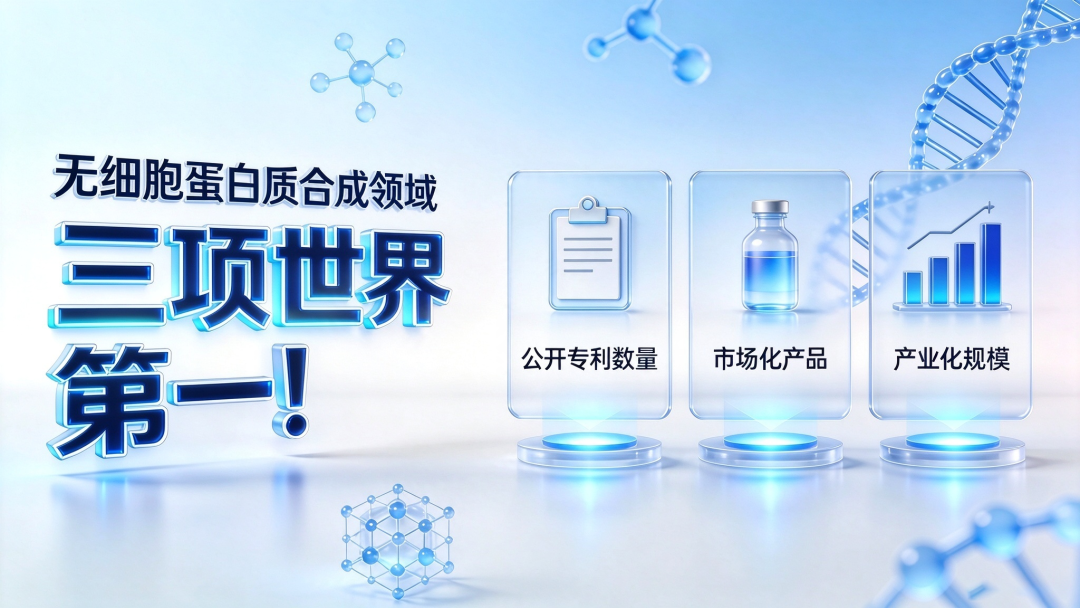
In the field of cell-free protein synthesis, Healthcode ranks first in the world in all three of published patents, industrialization scale and marketed products. With the full-chain advantages of leading technology, leading production lines, leading capacity and leading market, it continues to lead and advance the industrialization of cell-free protein synthesis worldwide.