阅读并同意隐私协议、MTA和使用条款后进行下一步!
MOLECULAR CLONING · SITE INTERPRETATION

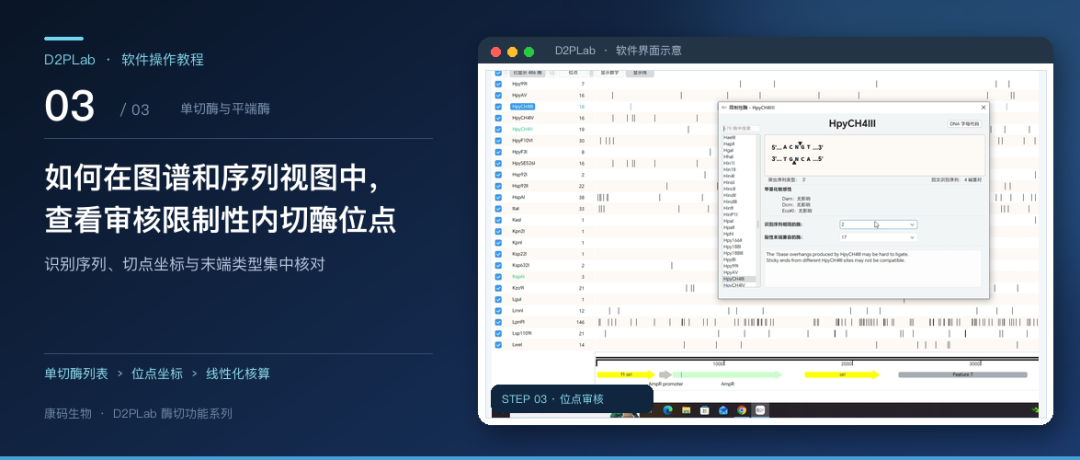
Cover | Cut-site coordinates and end types on the linearized map.
● ● ● IN BRIEF
To linearize a vector you need an enzyme that cuts only once in the current sequence; to ligate fragments that lack compatible sticky ends, you need to know which enzymes leave blunt ends. D2PLab uses single-cutter lists and enzyme-site annotation to put the recognition sequence, cut-site coordinates and end type of both single cutters and blunt-end endonucleases onto the map and sequence views, providing verifiable inputs for fragment-length calculations.
Restriction endonucleases cut double-stranded DNA to produce sticky or blunt ends. Sticky ends can pair by complementarity, improving ligation efficiency and enabling directional cloning; different enzymes may also produce the same compatible sticky ends — BglII and BamHI, for example — which leaves room for subcloning when the insert and the vector MCS sites do not correspond exactly. Enzymes that produce blunt ends, such as EcoRV (5′-GATATC-3′) and SmaI (5′-CCCGGG-3′), all cut in the middle of the recognition sequence; their products can be ligated to one another, but because there is no terminal base pairing, ligation efficiency is low and insert orientation is undefined.
Now the number of cuts. Treating a circular molecule with a single cutter, single digestion gives one linear fragment whose length equals the full length; double digestion gives two linear fragments whose lengths sum to the full length. Restriction mapping determines the relative positions of recognition sequences precisely by comparing single, double and partial digestion results. So the end type decides “whether it can ligate, and in which direction”, while the number of cuts decides “how many fragments, and how long each is” — only together do they make a predictable digestion.
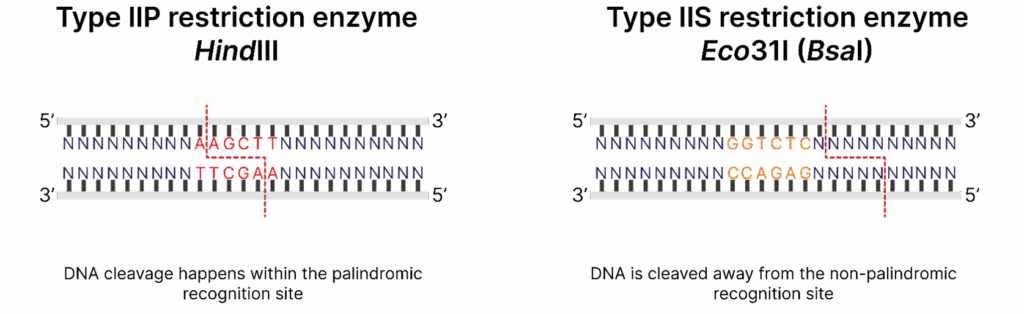
Figure 1 | Main types of restriction endonucleases.
The definition of a single cutter (Unique Cutters) is simple: only one recognition site in the current sequence. But finding that “unique” one in the whole enzyme library is not easy — whether the site falls inside the insert, or appears or disappears because the sequence version has been updated, must be confirmed one by one. Judging blunt-end enzymes is equally error-prone: relying only on the enzyme name or on intuition, it is easy to mistake an enzyme that produces 5′ or 3′ overhangs for a blunt-end enzyme, and then to misjudge ligation efficiency and direction.
Once the sequence is edited, all of these conclusions have to be recalculated. Reusing the “single cutter” conclusion from an old version to judge a new sequence is the most common source of error in fragment-length calculations. The judgement itself is not difficult; what is difficult is keeping the judgement in step with the current sequence.
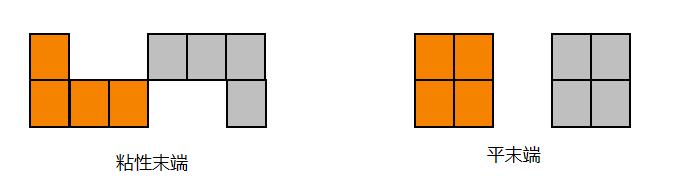
Figure 1 | Sticky ends and blunt ends.
The D2PLab interface lists the set of single cutters for the current sequence together with their number, removing the need to compare against the entire enzyme library one by one. After an enzyme is selected, the map hover shows the enzyme name, coordinates, recognition sequence and cleavage mode; the sequence view labels the enzyme name above the recognition sequence, so the context sequence at the cut site can be read directly. Switching to the linearized view arranges all cut sites by coordinate, making it easy to derive the number and length of products from site positions, to form expectations of band number and migration position, and to use them as a baseline for identifying positive clones. Blunt-end endonucleases are distinguished in the enzyme list by end type, avoiding the misjudgement of enzymes with staggered overhangs as blunt-end enzymes.
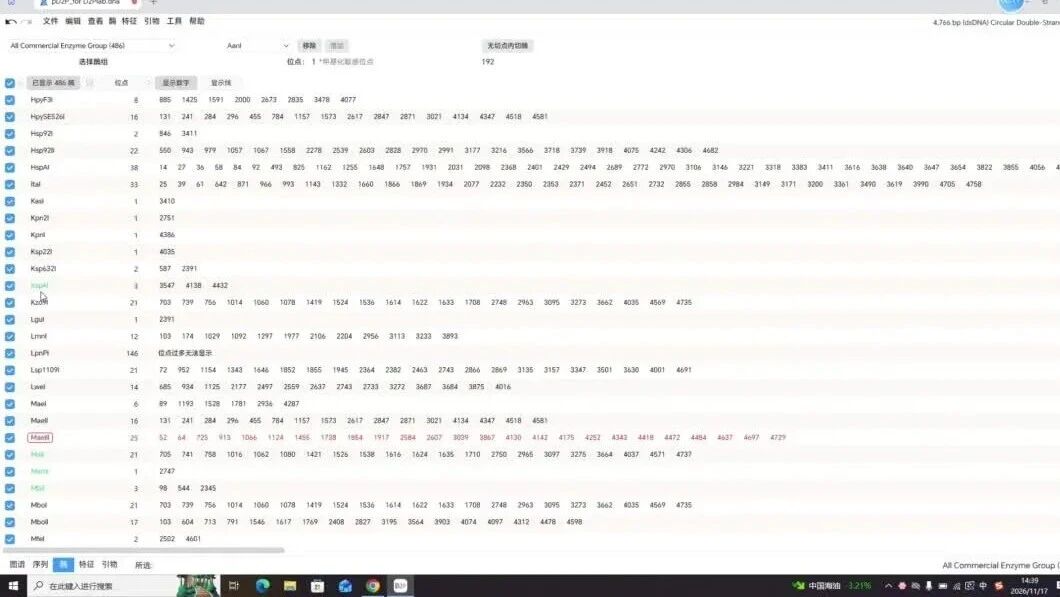
Video 1 | Walkthrough of the enzyme-site function in D2PLab (play in the original WeChat article).
Note
The determination of single cutters and blunt-end enzymes is based on the current sequence and must be recalculated after the sequence version changes; site annotation and length estimation are design-side criteria, and actual digestion, ligation direction and efficiency are subject to experimental verification. Interface menu names and display methods are subject to the current version of D2PLab.
Based on the world's leading cell-free protein synthesis industrialization technology, Healthcode has built the “EDA” of the biopharmaceutical industry — D2PLab molecular biology design tools — available for free download and use by research institutions and laboratories working in scientific research, drug discovery and AI protein design. D2PLab can run offline on a single machine and also supports networked computing: unified project management, AI remote large models and intelligent computing, and one-click submission for synthesis, covering the complete chain from sequence design to protein intelligent manufacturing. D2PLab has so far served more than a thousand laboratories, research institutions and AI technology companies worldwide.
Apply for a free download! Welcome to use: www.D2PLab.com
● ● ●